aa
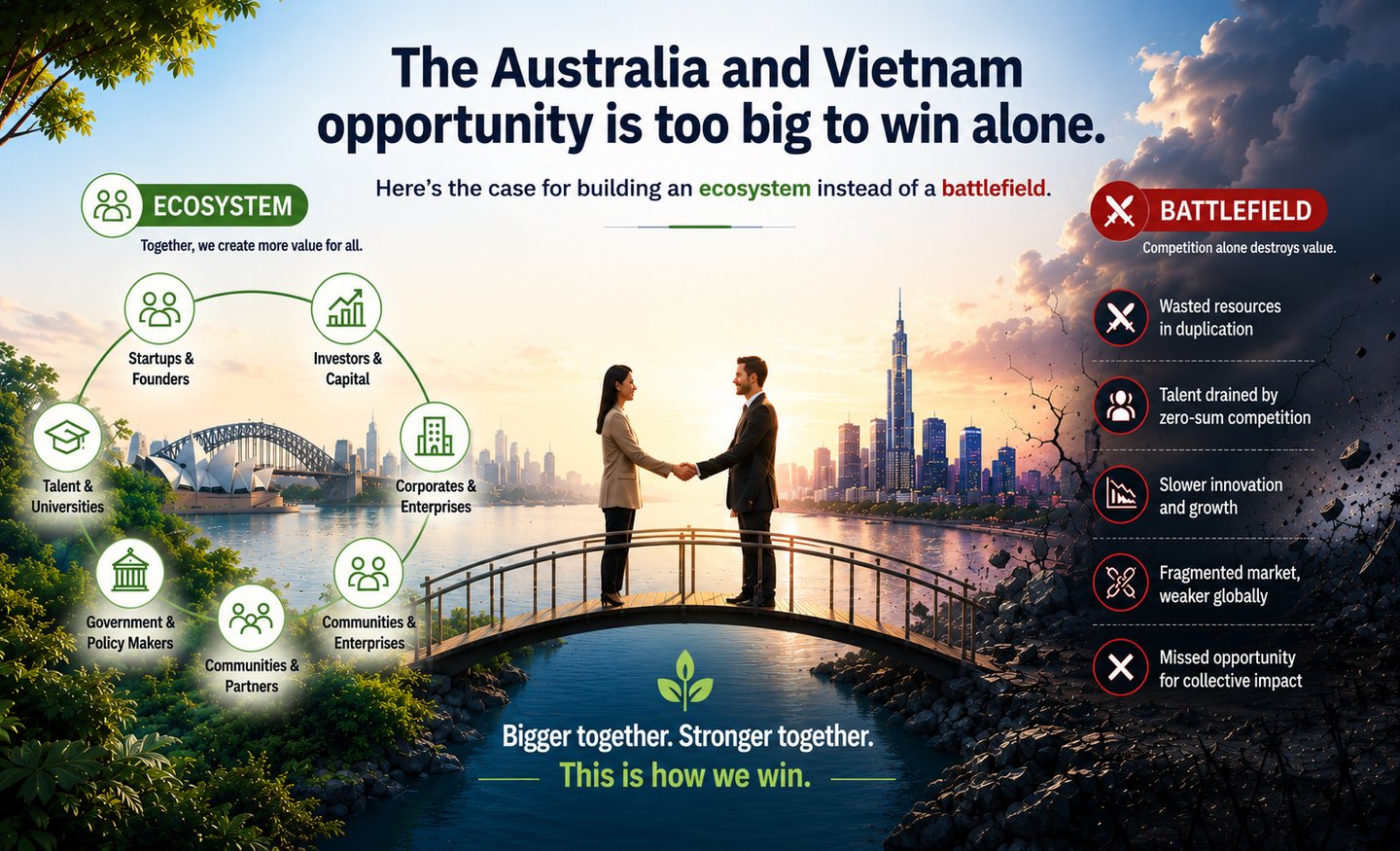
The Australia–Vietnam opportunity is too large for any one organisation to capture alone. Long-term success won't be built on isolated transactions but on trusted partnerships, complementary capabilities, and an ecosystem that enables businesses to enter, grow, and scale with confidence. This article explores why collaboration is becoming the real competitive advantage in one of the Indo-Pacific's most important economic corridors, and what it means for leaders building across Australia and Vietnam.
Anthony NG
6/27/20265 min read
Two-way trade between Australia and Vietnam hit around AUD $23 billion last year. Vietnam is now the fastest-growing economy in ASEAN. And still, most Australian businesses that go in walk out a year or two later with very little to show for it.
We've stopped blaming the market for that. The market is fine. The thing that gets in the way is closer to home, and it's something our own industry doesn't much like admitting.
Let me start with the part everyone agrees on. The window is genuinely open right now, and it won't stay open forever. Vietnam is aiming for close to 10% growth in 2026. Its retail market sits at roughly AUD $375 billion and keeps climbing. It hosts APEC in 2027. Brisbane hosts the Olympics in 2032. Two governments have done the hard diplomatic work of setting the table. The catch is that the advantage is moving quickly, away from companies that can enter a market and toward companies that can actually operate in one.
Which brings us to the real bottleneck. It isn't a demand. Its execution.
We've watched the same story play out more times than we can count. A capable company commissions a market study. The study is good. It says the demand is real, and it's right. Then the company runs straight into everything a study can't solve: standing up a real entity, finding a local partner who won't sink them, building something that scales rather than improvises, and keeping that partnership intact through two genuinely messy years. That's where most deals die. Not in the strategy. In the distance between the strategy and the ground.
Education tells the same story from a different angle. Australia and Vietnam have signed something like 36 university partnerships now, plus a fresh wave of MoUs. The intent is real. But a signed MoU and a program that actually runs are two very different things, and getting from one to the other takes someone willing to do the unglamorous work in between.
So here's what we don't say out loud. Most of us in cross-border advisory learned the business through a lens of scarcity. There are only so many deals. A referral we pass along is one we've given away. A competitor's win is our loss.
In a crowded, mature market, fair enough. That logic holds. But in this particular corridor, it's flat wrong, and it's quietly throttling the whole category.
The Australia and Vietnam corridor is under-served, not over-served. The thing in short supply isn't clients. Its execution capacity and trust. When an Australian business has a good first experience in Vietnam, the next one becomes easier to convince. When a program actually runs, the next university signs with more confidence. Every clean landing any of us pulls off lowers the perceived risk of the whole corridor, and everyone's boat rises with it.
Put bluntly: competition shrinks this category, and collaboration grows it. In a market this young, we don't think that's a nice sentiment. We think it's just the maths.
So we've started picturing the corridor as a relay rather than a cage fight. Trade and Investment Queensland, Austrade and DFAT sit at the front, generating leads, intelligence, and the government-to-government trust that nobody in the private sector can manufacture on their own. Then advisors, lawyers, accountants, distributors, universities and investors each do the piece they're actually good at. And someone has to sit across the top of all of it, making sure a lead doesn't vanish in the gap between the agency that found it and the company that has to land it.
That's the model we're building toward. TIQ generates the lead. The ecosystem converts it. Nobody's fighting over the same square inch, because we're each holding a different leg of the same race. And we'd genuinely rather build that with the people we're supposed to think of as competitors than against them.
As for where we fit, our work lives at three intersections this corridor keeps demanding: cross-border expansion and partnerships, transformation through systems and execution, and education and leadership for the AI era. We partner with leaders to get from a plan to actual performance, with operating fluency across Australia, Vietnam and the wider region, and relationships on both sides that run through government, industry and universities alike.
In practice, that turns into a fairly tight set of things, all of them aimed at the gap we just described. Market Entry as a Service takes a company from validating demand to running a live operation. Partner Sourcing and Due Diligence finds, checks and structures the right local partner, since the wrong partner is still the single most common reason entries fail. An Investment Bridge runs both directions, moving Australian capital into Vietnam and bringing Vietnamese investors toward Queensland opportunities, including the ones opening up around 2032. Underneath all of it sits the operating system that lets a new entity grow instead of stalling. We don't bring these as a walled garden. We bring them as our contribution to a table where other people are bringing theirs.
Education is where this whole argument is easiest to see. Earlier this year, Vietnam's National Innovation Centre and Trade and Investment Queensland convened the Education for Innovation Showcase in Hanoi, built around one idea: that learning should be wired directly into real business problems. Queensland's education exports were worth somewhere around AUD $6.89 billion in 2024. When a university, an industry partner and a connective advisor design a program together, nobody loses anything. What comes out the other side is graduates, capability and trust, and all three lift the corridor. That's the work we care about most, and it's not work anyone does alone.
An invitation
So let me be clear about who belongs in this conversation.
If you are an Australian business eyeing Vietnam or Southeast Asia, don't go alone, and don't go on a report. Find a network that can put you on the ground, hold the partnership together, and grow alongside you. The market is open. The hard part is the ground.
To Trade and Investment Queensland and aligned partners, let's complete the funnel together. You bring the leads, the intelligence and the trust. We bring the execution and the local networks. The corridor grows when the handshake at the top doesn't get lost somewhere on the way to delivery.
And to my fellow advisors, firms and operators in this corridor, let's stop guarding patches and start building the ecosystem. Refer. Co-deliver. Lift the whole category. We were never each other's real competition. The execution gap is. The people who collaborate are going to outgrow the people who hoard, every single time.
The corridor is going to get crossed either way. The only open question is whether we build the bridge together, or keep charging each other tolls on a road nobody's finished paving.
We know which one we'd pick. If it's the one you'd pick too, let's talk.
Copyright 2026 © staaustralia.com.au